1 min read
HUD OIG Report Highlights Fraud Risks in Single Family Housing Program
HUD OIG recently released a 39-page report on February 17, 2026, which is particularly interesting for its detailed examination of potential fraud...
5 min read
The HUD OIG released a report on May 19, 2026, titled "HUD Did Not Pursue Repayment for Improper Payments on Claims Without Conveyance of Title." This summary provides specific highlights and direct excerpts from the document, though it is not an exhaustive account of the entire report.
An important highlight from the Report, the Office of Single Family Housing management disagreed with taking any action under recommendation 1C and stated that it exercised its enforcement discretion for any violation involving a servicer bidding total debt instead of CAFMV on foreclosure and post-foreclosure sales that occurred prior to July 24, 2025, which was after issuance of FHA INFO 2025-36, Reminder Guidance for FHA-Approved Mortgagees Regarding Claims Without Conveyance of Title Bidding Policy. The Office of Single Family Housing made this decision due to conflicting instructions it previously provided to mortgage servicers and industry participants. It will review the identified claims to determine if the CAFMV was used but does not anticipate taking any action unless the review reveals a violation that does not involve a total debt bid.
1C Recommendation:
“1C. Obtain documentation for the $2,456,294 in potential findings related to use of the Commissioner’s Adjusted Fair Market Value identified by the MCM contractor to support that the claims paid were fully eligible, or demand and collect repayment from the lenders for the amount of improper CWCOT payments identified. “
HUD OIG Response to the Above:
OIG appreciates the Office of Single Family Housing’s willingness to take actions to fully address the recommendations cited in the report. Regarding recommendation 1C, although the Office of Single Family Housing does not anticipate taking any action, OIG appreciates its commitment to review the identified claims to determine whether the CAFMV was used, as recommended in this report. OIG also acknowledges the Office of Single Family Housing’s explanation of the enforcement discretion it applied to cases involving total debt bids prior to the issuance of FHA INFO 2025-36 and the historical inconsistencies in guidance that contributed to these circumstances. OIG will work together with the Office of Single Family Housing through the audit resolution process to fully address this issue, ensure alignment on the applicable requirements, and determine any next steps needed to resolve the recommendation.
Excerpts from the Report below:
Purpose of the Audit:
“To assess whether HUD was appropriately demanding and collecting improper payments identified for CWCOT loans by its Mortgagee Compliance Manager (MCM).
To assist HUD in recovering improper payments and to reduce the risk of losses to the FHA insurance fund.“
The CWCOT program, which has been in effect since 1987, encourages third parties to purchase properties at foreclosure sales instead of having lenders convey the property to HUD as is done with other FHA insurance claims. By allowing bids that do not amount to the total debt owed on the property, the program seeks to decrease the number of properties in HUD’s inventory.
HUD uses CWCOT sales to reduce the time properties sit vacant, while reducing losses and improving recoveries for FHA’s Mutual Mortgage Insurance Fund. HUD also reimburses the lenders for certain costs associated with the foreclosure and sale of the property. HUD’s Office of Single Family Asset Management and National Servicing Center oversee the disposition of foreclosed FHA properties through the CWCOT program.
What HUD OIG Found:
“HUD has not been making demands for or collecting repayment of improper payments identified by the MCM contractor during its CWCOT reviews. These improper payments included amounts:
(1) calculated by the contractor for the categories of CWCOT review findings defined in its contract;
(2) related to HUD’s property preservation and protection cost requirements that were not included in the MCM contract’s CWCOT review scope of work, and
(3) for findings related to appraisal issues that the contractor did not monetize. “
Not all findings identified by the MCM contractor were properly tracked and referred.
“These conditions occurred because HUD did not ensure CWCOT demand-for-repayment processes were ever implemented or provide adequate oversight to its MCM contractor. As a result, HUD paid improper claims and failed to recapture more than $10.5 million determined to be owed.”
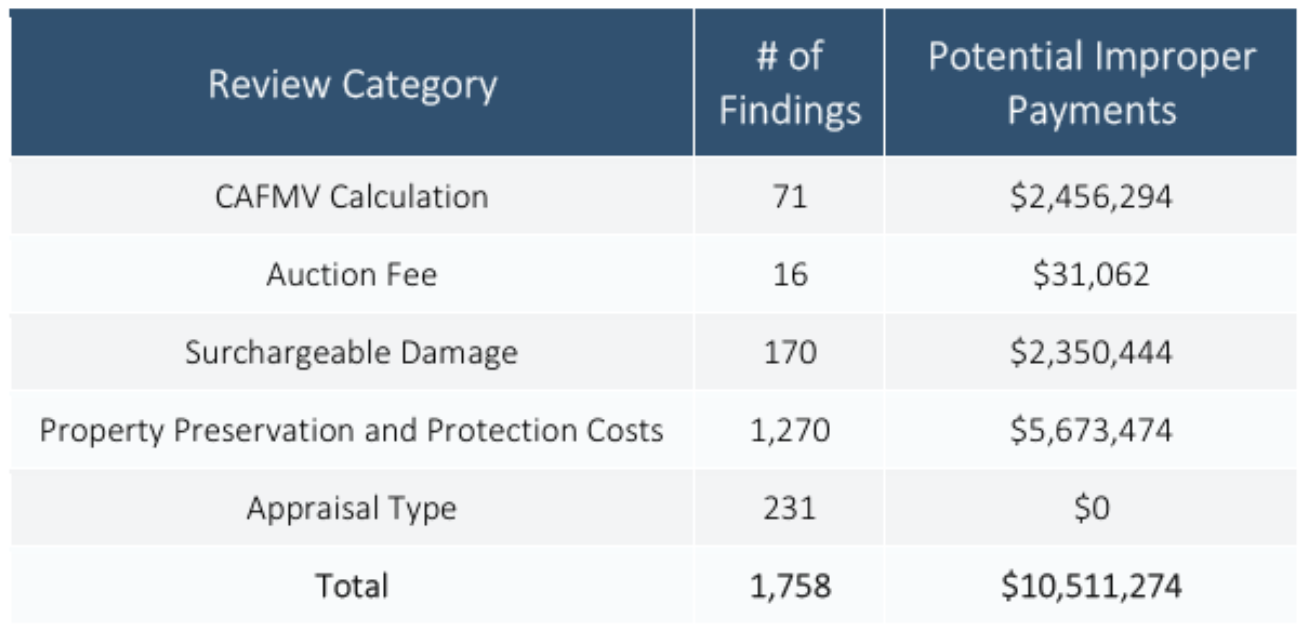
HUD did not pursue repayment of more than $10.5 million identified by its MCM contractor related to 1,758 findings on CWCOT cases it reviewed during the 2-year audit period of March 2023 through February 2025. In addition, HUD did not provide guidance on how to calculate repayment amounts for appraisal-type findings on loans with $7.5 million in total claims, therefore, the total improper payment amount is likely more than the approximately $10.5 million identified. The figure below provides a summary of the contractor’s findings of these improper payments categorized by review category:
Incorrect CAFMV:
HUD did not pursue administrative remedies for 257 findings totaling more than $4.8 million that related to areas included in the MCM contract scope of work for CWCOT reviews. As part of its contract with HUD, the MCM contractor reviews every CWCOT loan once the claim is filed and paid through FHA. Specifically, the MCM is required to review the CAFMV amount, the auction fee charged to HUD, the bid amount, and any unrepaired surchargeable damage for all CWCOT loans.
HUD’s Single Family Housing Policy Handbook 4000.1 provides specific requirements for CWCOT that relate to these areas included in HUD’s MCM contract scope of work. Specifically, the Handbook states the following:
Lenders must access the CAFMV link in HUD’s FHA Connection system to determine a property’s CAFMV, using the appropriate appraisal for the CAFMV calculation
Lenders are only authorized to bill HUD at a maximum of 5 percent of the sales price for the auction fee. Lenders must use the correct bid amount, depending if the lender or a third-party is bidding and winning the auction.
There cannot be any unrepaired surchargeable damage.
According to the MCM contract, if any of these above requirements are not met, the MCM contractor is to pursue an administrative remedy against the lenders for the corresponding improper overpayment(s) including demand for repayment.
HUD OIG identified 71 potential overpayments when the incorrect CAFMV was used totaling $2,456,294, 16 potential overpayments when the auction fee was higher than the allowed 5 percent, totaling $31,062, and 170 potential overpayments when there was unrepaired surchargeable damage totaling $2,350,444. However, HUD or its contractor did not notify the lenders of these findings or pursue repayment for the amounts.
Property Preservation:
The MCM contractor was not required in the contract scope of work to look for property preservation and protection overpayments. Even though the MCM contractor was not required to look for these overpayments, HUD nevertheless requires a lender to repay unnecessary or excessive expenses that were outside the scope of property preservation and protection actions, were not performed properly or completely, or exceeded the maximum cost allowance of $5,000 per property. Despite HUD’s contract not including the requirement to look for property preservation and protection overpayments, in March 2023, HUD’s Contracting Officer Representative (COR) instructed its MCM contractor to review CWCOT loans for these potentially costly overpayments.
Recommendations to HUD per HUD OIG:
“HUD’s Deputy Assistant Secretary for Single Family Housing to: (1) update and implement processes, procedures, and the MCM contract for CWCOT reviews to fully align with CWCOT requirements going forward; (2) obtain documentation to support that the claims paid in cases where the MCM contractor identified potential findings of more than $10.5 million were fully eligible or demand and collect repayment from the lenders for the amount of improper CWCOT payments identified; (3) determine the amount owed for improper payments made to lenders for CWCOT cases that the MCM contractor identified as having potential findings related to appraisals and demand and collect repayment for the determined amount; and (4) enhance oversight of the MCM contractor including, but not limited to, reviewing its CWCOT reports for verification and validation and providing the review results for further review, validation, and referral as needed.”
1 min read
HUD OIG recently released a 39-page report on February 17, 2026, which is particularly interesting for its detailed examination of potential fraud...
1 min read
On June 25, 2026, the Office of Inspector General for the United States Department of Housing and Urban Development published a Report entitled, “HUD...
1 min read
The U.S. Department of Housing and Urban Development's Office of Inspector General released its Annual Work Plan for Fiscal Year (FY) 2026 (covering...